



When you explore biology, you’ll find that many processes are constantly occurring in living organisms. The study of organic chemistry — which focuses on carbon molecules — is central to all living organisms.
5.12 is an introduction to organic chemistry, focusing primarily on the basic principles to understand the structure and reactivity of organic molecules. Emphasis is on substitution and elimination reactions and chemistry of the carbonyl group. The course also provides an introduction to the chemistry.
The ability to convert ingested fuel to usable energy is what differentiates a living organism from a dead one. The ingested fuel contains a variety of large molecules (macromolecules) that get broken down. When the macromolecules have been broken down into their smallest parts, they can enter the cells, which contain more macromolecules, which are involved in more processes.
What is organic chemistry?
- Over the years of teaching organic chemistry I’ve developed a huge (and constantly growing) collection of organic chemistry study notes and cheat sheets. Currently, I have over 250 pages of detailed notes on virtually every topic in a typical organic chemistry course with full curved-arrow mechanisms and tricky points explained in details.
- Welcome to organic chemistry! Start here with a deep dive into basic hydrocarbons: nomenclature, structure conventions, properties, and isomers. Work towards a deep understanding of the principles and skills that you will draw upon for the entire course.
In organic chemistry, the focus is on the element carbon. Carbon is central to all living organisms; however, thousands of nonliving things (such as drugs, plastics, and dyes) are made from carbon compounds. Diamonds are carbon atoms in a crystal structure. Diamonds are so hard because the atoms of carbon are so closely bonded together in the crystal form. That same ability to pack closely together makes carbon an excellent structural element in its other forms as well.
One atom of carbon can combine with up to four other atoms. Therefore, organic compounds usually are large and can have several atoms and molecules bonded together. Organic molecules can be large, and they comprise the structural components of living organisms: carbohydrates, proteins, nucleic acids, and lipids.
Organic Chemistry Study Guide
Carbon is key

In their outer shells, carbon atoms have four electrons that can bond with other atoms. When carbon is bonded to hydrogen (which is common in organic molecules), the carbon atom shares an electron with hydrogen, and hydrogen likewise shares an electron with carbon. Carbon-hydrogen molecules are referred to as hydrocarbons. Nitrogen, sulfur, and oxygen also are often joined to carbon in living organisms.

Long carbon chains = low reactivity
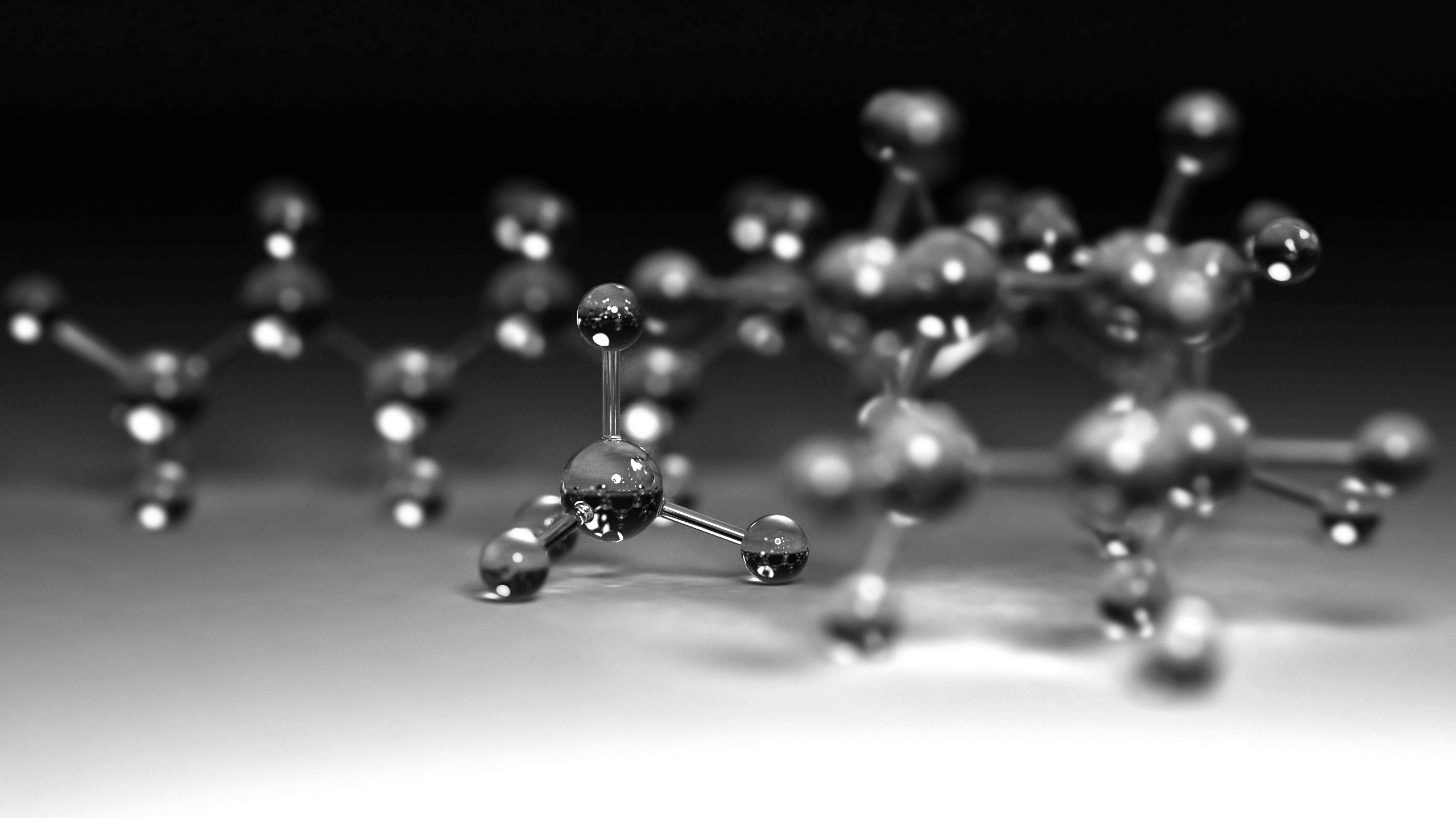
Large molecules form when carbon atoms are joined together in a straight line or in rings. The longer the carbon chain, the less chemically reactive the compound is. However, in biology, other measures of reactivity are used. One example is enzymatic activity, which refers to how much more quickly a certain molecule can allow a reaction to occur.
One key to knowing that a compound is less reactive is that its melting and boiling points are high. Generally, the lower a compound’s melting and boiling points, the more reactive it is. For example, the hydrocarbon methane, which is the primary component of natural gas, has just one carbon and four hydrogen atoms. Because it is the shortest carbon compound, it has the lowest boiling point (-162°C) and is a gas at room temperature. It is highly reactive.
On the other hand, a compound made of an extremely long carbon chain has a boiling point of 174°C (compared to water, which has a boiling point of 100°C). Because it takes so much more for it to boil, it is much less reactive and is not gaseous at room temperature.
Organic Chemistry Nomenclature

Organic Chemistry Tutor Youtube
Forming functional groups based on properties

In organic chemistry, molecules that have similar properties (whether they are chemical or physical properties) are grouped together. The reason they have similar properties is because they have similar groups of atoms; these groups of atoms are called functional groups.
Chemical properties involve one substance changing into another substance by reacting. An example of a chemical property is the ability of chlorine gas to react explosively when mixed with sodium. The chemical reaction creates a new substance, sodium chloride (table salt). Physical properties refer to different forms of a substance, but the substance remains the same; no chemical reaction or change to a new substance occurs.
Organic Chemistry Related People
Some of the properties that the functional groups provide include polarity and acidity. For example, the functional group called carboxyl (-COOH) is a weak acid. Polarity refers to one end of a molecule having a charge (polar), and the other end having no charge (nonpolar). For example, the plasma membrane has hydrophilic heads on the outside that are polar, and the hydrophobic tails (which are nonpolar) form the inside of the plasma membrane.